
01
Where is the force?
Identify where a force contacts the body and the direction it pushes or pulls. That gives you the starting point for understanding the exercise.
A 148-page visual guide to the principles underneath every exercise in the gym. Learn how to look at force, torque, movement, muscle bias, and stability so you can understand why an exercise works—and how to change it when it doesn’t.
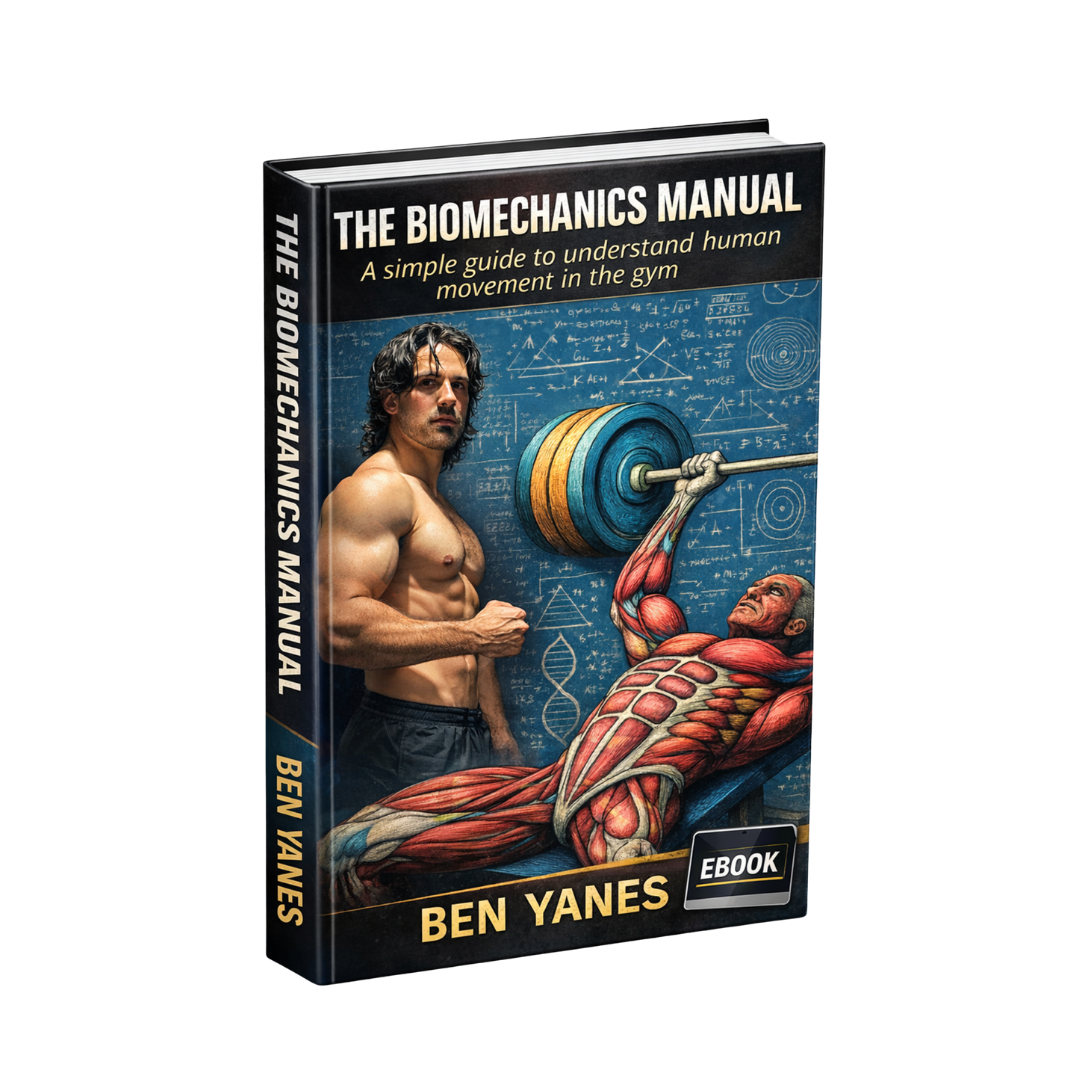
Most people see a bench press, a row, a squat, or a lateral raise as a category. This manual teaches you to look underneath the name: Where is the force? What is it trying to rotate? Where is the exercise heavy or light? What muscles can oppose it? Once you can answer those questions, the gym becomes a lot less mysterious.
The point isn’t to give you another list of “best exercises.” It’s to teach you principles that transfer from one exercise, machine, body, and problem to the next.
The manual repeatedly brings complex biomechanics back to simple first-principles reasoning.
Identify where a force contacts the body and the direction it pushes or pulls. That gives you the starting point for understanding the exercise.
Follow the force to the joint. Which rotation does the exercise create? Now you can work backward toward the muscles involved.
Compare torque throughout the range. See where leverage increases, where it falls away, and how a small setup change can reshape the entire exercise.
One of the most useful ideas in the manual is learning to compare the relationship between a force and a joint axis. Once you can see moment arms, you can begin to predict where an exercise challenges you most—and deliberately move that challenge.
At its simplest: when a force meets a segment at 90 degrees, that force has its best ability to rotate it.
The chapters build on each other so you’re not just learning definitions—you’re learning how to use them to understand real exercises.
Start with the central idea: muscle contraction is a response to force.
Learn to identify point of contact and direction, then work backward from the effect on the body.
Understand rotational challenge, axes, moment arms, and why leverage changes throughout an exercise.
See joints as rotations and bones as arcs instead of assuming your body follows the machine or weight.
Learn why challenge changes through a range of motion and how to alter where an exercise is hardest.
Reason from muscle action, fiber direction, stretch/shortening, and force to make an exercise more specific.
Understand anchors and opposing forces so you can see why support changes what the rest of the body has to do.
Use what you notice in the real world to refine your understanding instead of treating theory as the final answer.
Stop blindly copying setups. Understand why an exercise feels the way it does, how to target the muscle you want, and what you can change when something isn’t working.
Build a more precise language for what you’re observing so you can explain, adjust, and individualize exercises instead of relying on memorized rules.
Turn terms like force, torque, moment arm, axis, muscle bias, and stability into concepts you can actually use on the gym floor.
“This book is phenomenal both in theory and practical application. The concepts you talk about are ones I’ve had both in my own head and also use in practice as a physical therapist. I’m so glad that someone has made the concepts of moment arms and lengthened vs shortened positions directly applied in an educational context.”
“The manual explains biomechanics in a very simple yet incredibly detailed way. I liked how it teaches principles through examples and tasks that actually got me to think for myself, which is why so much of it has stuck.”
“The manual’s ability to simplify complex concepts and break them down into clear components is a game changer. I already have some of your products, and every time I read your stuff, the picture gets clearer.”
You don’t need another list of exercises to memorize. Learn the principles underneath them and give yourself a way to reason through the next exercise, machine, client, or problem you encounter.
One-time purchase.

Get started today before this once in a lifetime opportunity expires.